
Parquet subfloor: survey protocol before ordering material
Parquet rarely fails because of the species — more often because of a substrate nobody checked before ordering material.
The real question is whether to glue on schedule or first measure moisture, flatness and pull-off strength.
Here is parquet subfloor prep as a project gate: what we measure, when we stop, and why the survey comes before the batch goes into production.
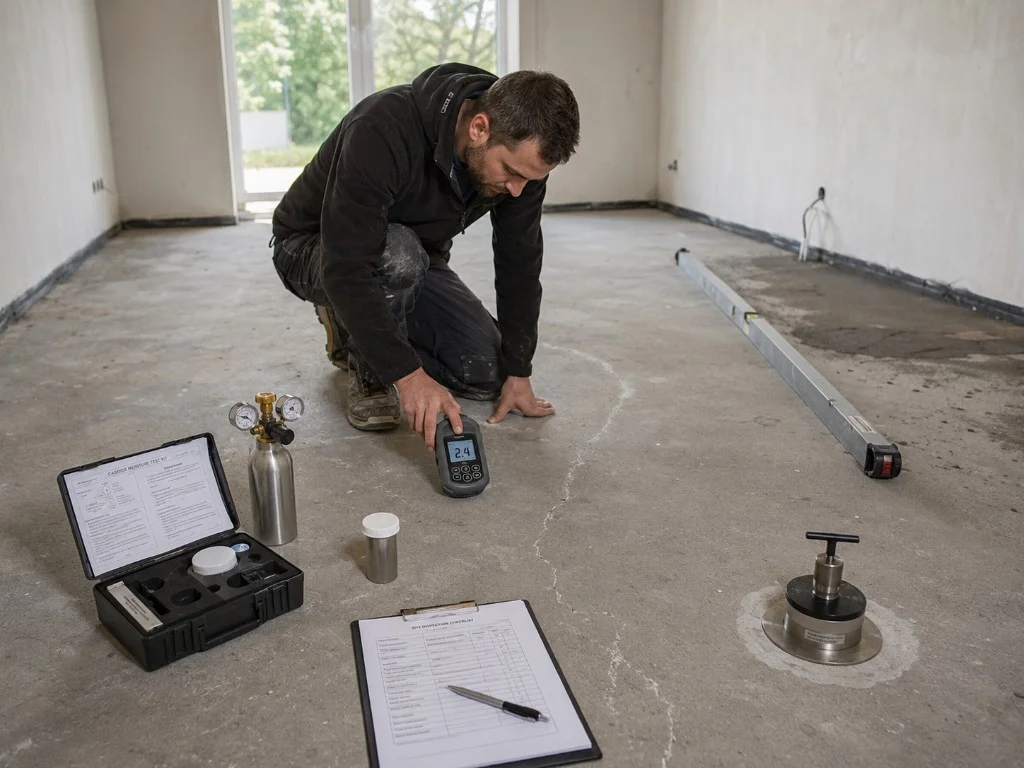
Subfloor quality governs floor life more than the oak you pick in a catalogue.
At Cardinal Hall the site is surveyed before the batch enters production — so boards are not delivered to an unready screed and schedules are not argued on site.
This is a gate article: diagnosis and a pass / remediate call. The full installation tech card is the next track — not this one.
Why survey before ordering material?
The laying method (plywood + polyurethane or silane on screed), build-up height and junction tolerances depend on what actually sits under the future floor.
Ordering a batch “to a pretty sample” and then changing the card because of moisture or cracks means losing the calendar — and sometimes the batch itself.
The survey protocol locks facts: moisture, flatness, pull-off, defect map. Without it, production and install are a lottery.
What is the logic of CM vs a hygrometer?
The carbide method (CM) shows moisture through the screed depth — adhesive schedules and concrete / anhydrite tolerances often require it.
A surface hygrometer is useful for screening and mapping “hot” zones, but it does not replace CM where the adhesive maker asks for a documented method of its own.
We take both tracks per the adhesive tech card and screed type. “Dry to the touch” and “the screed is three weeks old” are not a protocol.
What does pull-off strength tell you?
Sample pull-off shows whether the screed surface can hold a “primer + adhesive + parquet” system — or whether laitance and a weak layer will fail.
Low pull-off is a stop: grind / mill the weak layer, strengthen, sometimes a new screed. You cannot “glue harder” over a weak field.
The result sits in the protocol next to moisture and flatness — three numbers decide whether a laying date is even discussable.
Cracks and moisture bridges — when is it a stop?
Crack map: hairline shrinkage, through cracks, live movement. A live crack and a moisture bridge from wet zones (bath, external wall, ground) are not cosmetic filler “for the photo”.
Moisture bridges are found by measurement and build logic: where water enters, where vapour exits, whether waterproofing is at risk.
Until the cause is fixed, the batch does not come to site. Otherwise the floor becomes an expensive, useless leak sensor.
How do timber joists differ from a concrete screed?
Concrete / anhydrite: CM and hygrometer moisture, flatness, pull-off, cracks, waterproofing. Then the install card follows the tolerance.
Timber floors: joist stiffness, squeak, subfloor ventilation, rot and beetle, compatibility of thickness and method with a “live” base.
On joists a plywood card and reinforcement are more common than dreaming of thin silane “like the neighbour’s screed flat”. Substrate type dictates method — not the reverse.
When do we stop and remediate?
Stop if moisture exceeds the adhesive limit, flatness is worse than the guide (≤ 2 mm per 2 m), pull-off is weak, cracks are live, moisture bridges remain, joists move or the void is unventilated.
Then we write a technical fix: levelling, strengthening, waterproofing, joist reinforcement, method change — and only after a readiness certificate do we call the batch.
Priming for the adhesive type, local levelling and a perimeter damper are prep for install — not a substitute for diagnosis.
Can you lay parquet over old flooring?
Only after adhesion, moisture, junction-height and old-layer diagnostics. Sometimes old parquet or tile holds; more often it hides a wet or weak base.
In practice, on premium jobs it is often cheaper to remove and prep the base anew than to open the field a year later under furniture and oil.
A photo of “the old floor looks fine” is not a measurement. The call sits in the protocol — not in chat.
What follows a readiness protocol?
The readiness certificate opens the calendar: acclimatisation of a single batch, laying by the chosen card, finish and handover — see installation as engineering.
Before the protocol, production may reserve species and grading, but physical delivery to an unready site is a risk we do not take by default.
In brief
When to survey the substrate — before or after ordering parquet?
How does CM differ from a hygrometer?
What flatness deviation is acceptable?
Can parquet be laid over old flooring?
What matters most on timber joists?
When must install not start?
Need a site diagnosis — describe the floor or joinery.
Request a quote