
Parquet installation: tech cards and geometry control
Premium parquet rarely fails because of the species — more often because of install without a protocol: moisture unchecked, gaps forgotten, finish laid on unstable geometry.
The real question is whether to glue “as usual” or run the job as an engineering discipline with acceptance gates.
Here is parquet installation without fairy tales: two method cards, checkpoints before start, acclimatisation, expansion and handover with a site service card.
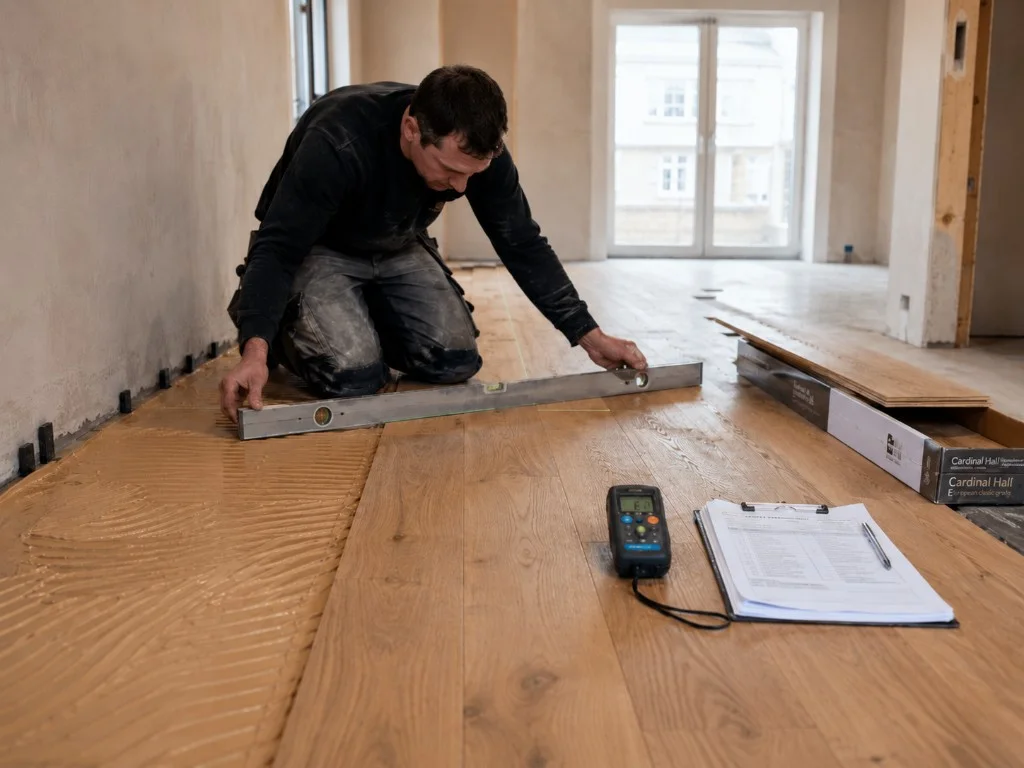
Parquet installation in a residence is not “glue-down from a classified ad” and not speed for a portfolio shot.
It is a tech card: method chosen at audit, substrate accepted by protocol, batch acclimatised, joints and finish aligned with doors and panels.
Without a signed previous stage, the next does not start. Otherwise within a season you pay for rework — not for the floor.
How is install different from “glue-down by the ad”?
Ads sell square metres and a move-in date. On site what matters is moisture, flatness, pull-off strength, the perimeter and adhesive compatibility with the floor build-up.
Cardinal Hall installs in-house production by the site card: from substrate survey to finish handover. The batch is reserved for the project — see one wood batch.
The substrate is a separate track. If the screed or joists are out of tolerance, first subfloor preparation, then adhesive and boards.
Plywood and PU, or silane on screed?
Traditional card: moisture-resistant plywood on polyurethane adhesive, sanding of each layer, boards laid with a perimeter damper. Holds complex and “live” substrates, heritage buildings and projects that need height compensation for uneven bases.
Modern card: direct bond on a prepared screed with silane adhesive. Lower build-up, faster calendar — but only with confirmed moisture and flatness in tolerance.
We choose the method at audit — not “by default” and not because it is faster. Changing the card after the batch arrives is already a planning failure.
What acceptance gates before start?
Installation does not begin without documented substrate moisture, flatness deviation (guide: up to 2 mm per 2 m), pull-off strength, waterproofing in risk zones and batch acclimatisation in the target room climate.
Block geometry is controlled in production (±0.5 mm). On site we check junctions with openings, skirting and fitted furniture from the same batch.
No protocol for the previous stage — no next shift. “We’ll measure later” does not exist in the premium track.
Why acclimatise the batch?
Parquet is held in the target room climate (guide 40–60% RH, project temperature) for at least the tech-card and adhesive schedule.
Doors and panels from the same batch acclimatise in parallel so floor and joinery reach working moisture together.
Skip this step and you get gaps, crowning and “two tones” already at handover — especially on solid and wide formats.
Are expansion gaps just “pretty cracks”?
Wood moves. Perimeter, thresholds, junctions with stone, metal and glass are designed with compensation and profile — before laying, not “trim on site”.
A moisture barrier and perimeter damper are part of the engineering card, not an option. Without them the floor works against the wall and the door frame.
Joints align with a single batch: skirting, portal and kitchen front from the same material do not forgive improvised gaps.
When does finish go on after install?
After the adhesive has cured — multi-pass sanding, joint filling, dust extraction and oil or lacquer per schedule (including Saicos, Osmo and equivalents).
Coat count and finish system are aligned with doors and panels from the same batch — otherwise one room shows “two oaks”.
Finish on unstable geometry or before joints settle is a common cause of early wear and peel.
Can you start install without a substrate protocol?
In the same sense you “can” glue onto a wet screed: the adhesive will stick; within a season the floor may not.
In practice, without moisture, flatness and pull-off protocols you get play, wall gaps and board lift — then it is not “tighten the skirting” but open the field.
If the base is not ready — we stop and go to survey and preparation. An honest pause is cheaper than rework after furniture.
How does site handover run?
The calendar is in the contract: delivery, acclimatisation, laying, finish, acceptance. The next stage only after a signed previous one.
At handover you get a service card: climate, care products, seasonal check schedule. Full turnkey cycles usually run 8–16 weeks — area, pattern and scope.
Need a new floor or install of our production only — we read the site track, not an average per-metre rate.
In brief
Which method: plywood or silane?
What flatness tolerance before install?
Do you install third-party parquet?
Is acclimatisation needed if the parquet is “already dry”?
When do you apply oil or lacquer?
How are installation dates fixed?
Need a site diagnosis — describe the floor or joinery.
Request a quote