
One timber lot: why “the same oak” drifts in 15 years
“The same oak” on the floor and the door rarely splits on install day.
The gap shows up in 5–15 years: UV, wear and different finish chemistry finish what only “almost matched” at handover.
Here is one timber lot without slogans: why one species is not one lot chemistry, when a reserve is mandatory, and when sample approval is enough.
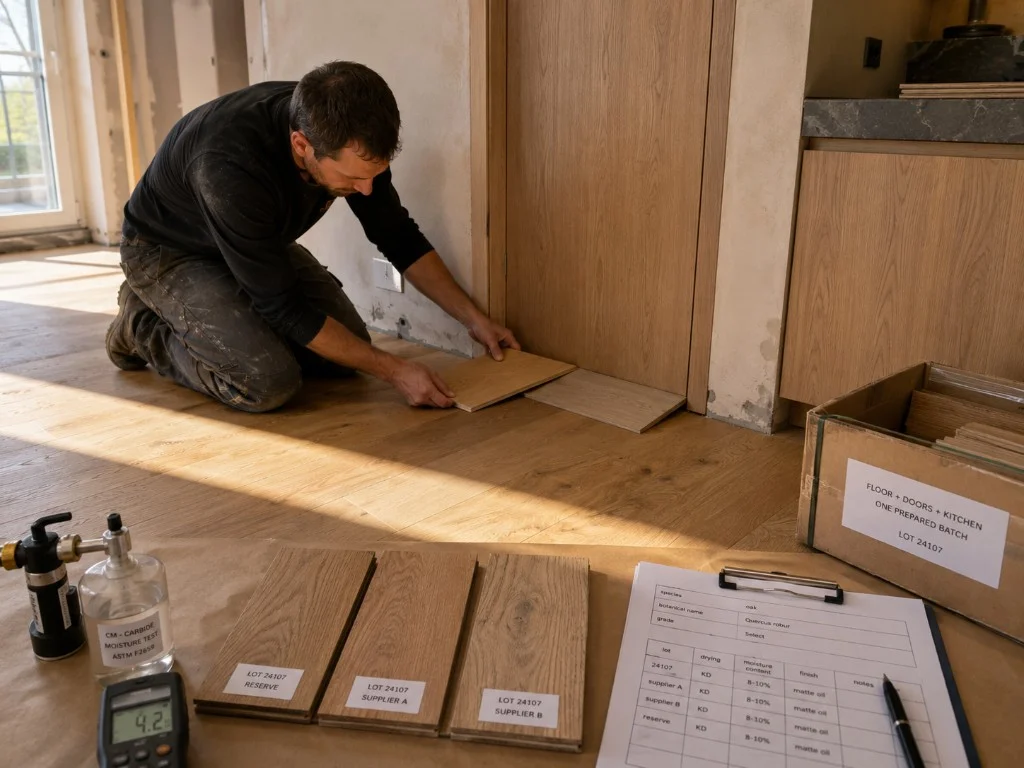
One batch is not “nice oak everywhere”. It is one prepared timber lot for floor, doors, stairs, kitchen, panels and fitted furniture: one grading, one drying regime, one finish tech card.
Different manufacturers may share only the species name — not extractives, drying or oil/lacquer chemistry. On site that shows later, at the junctions, after years.
What follows is colour science and reserve logistics. Without them, post-handover tone matching becomes a project of its own.
Why one species is not one lot
Even within Quercus or Juglans, lots differ: growth region, stem age, heartwood/sapwood share, tannins and resins. Two “identical” oak boards can take tone differently and yellow differently under UV.
Drying changes colour and internal stress: a short market cycle and a long kiln protocol leave different residual moisture profiles and different reactions to finish. Moisture at the moment oil or lacquer is applied is another hidden variable.
Finish is separate chemistry: oils, hardwax-oils and lacquers do not age in sync. If the floor is from one mill and the doors from another, a decade later “one oak” often reads as two materials.
What light does in 5–15 years
UV and daylight break down and rebuild lignin and pigments in the surface layer. Speed depends on species, tone, finish type and window orientation — not on the word “oak” in the spec.
Wear adds a second axis: a traffic path dulls and abrades faster than a front behind the sofa. With different lots, both axes amplify divergence at junctions — threshold, skirting, door leaf, kitchen front.
That is why “close enough in the showroom” is a weak criterion. You need a shared lot and a shared finish schedule under your light — not on-site tinting after the fact.
When one batch is mandatory
Mandatory when wood reads as one architecture: open floor↔kitchen plan, doors and portals matched to the floor, stairs and panels as a continuation of the plane, long sightlines without a material break.
Also for phased delivery of one volume (wing now / wing in a year) and when reorder of furniture or expansion is already known. Then reserve and sample archive are insurance, not an option.
At the kitchen↔floor joint see the floor and kitchen from one batch guide: steam, grease and install sequence are stricter there.
When sample approval is enough
Optional when zones are visually broken: separate floors without a through-view, closed rooms, wood as a local accent only, or a floor already closed under another protocol while new doors are a separate scope.
Then we lock samples in your lighting, a finish protocol and an “close, not identical” tolerance. We do not promise a ten-year match — and we say so before contract.
It is more honest to price divergence upfront than to sell “the same oak” from another mill as a guaranteed clone.
How reserve and reorder work
At start we reserve species and grading for the known volume plus repair stock of blocks and blanks. Drying follows the manufactory protocol (280 days): geometry and moisture are set before finish — not “persuaded” on site with a mallet.
Finish is applied under one card for every item in the lot. Samples and regime notes go into the object archive — for repair and phase two.
Reorder from a new lot is possible: extended matching, samples in your light, explicit tolerance. That is no longer “the same batch” — it is controlled approximation.
How a project runs with us
Survey and product map → lot and grading reserve → drying and geometry → unified finish → one install team on axes and junctions → handover with sample archive.
Kitchen, doors and fitted furniture meet the floor in one production queue — not “by eye at the end”. Catalogue — production; kitchens — kitchen line.
In brief
Can I order only the floor and doors later?
Why does “the same oak” from different mills diverge?
When is one batch mandatory?
What if another contractor already laid the floor?
Do we need repair stock?
Is one batch only about colour?
Need a site diagnosis — describe the floor or joinery.
Request a quote