
280-day drying: wood moisture and ±0.5 mm calibration
A plank can look ready in weeks — and still move a season after install.
The cause is rarely the fitter alone: moisture and stress across the section were never equalised before finish.
Here is drying as physics and as manufactory protocol: kiln exit ~9±1%, in-service ~6–8% in heated interiors, ±0.5 mm as machine calibration — and what 280 days means in practice.
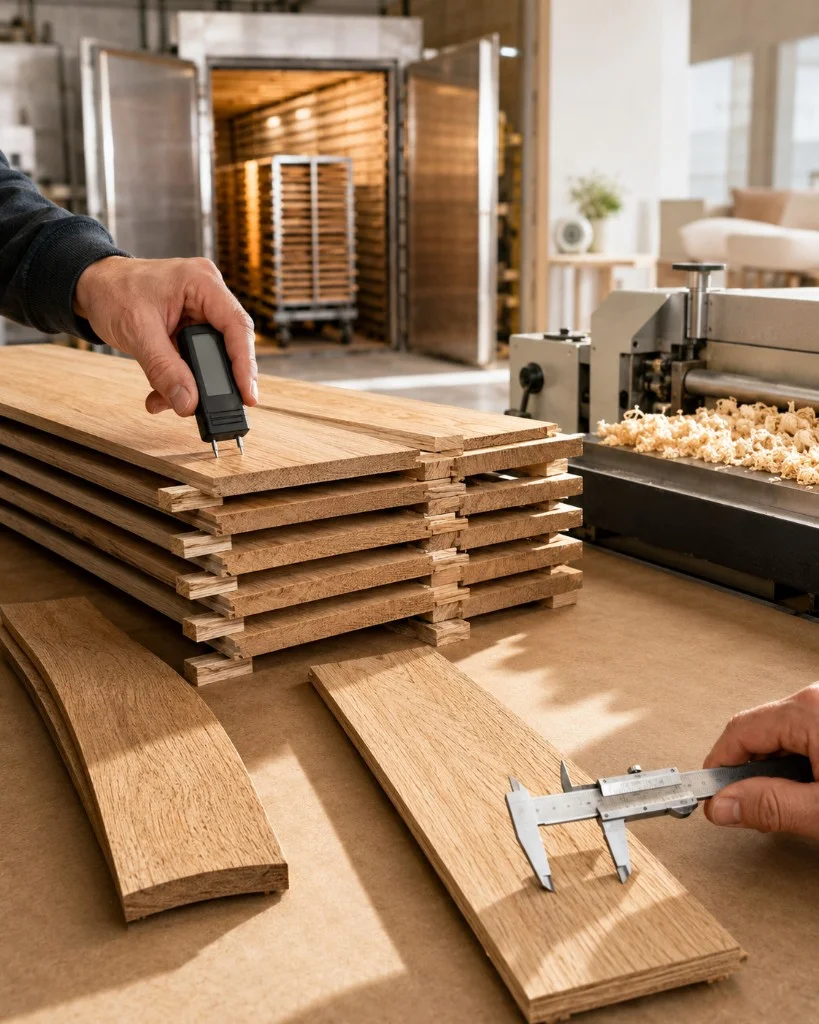
Wood always moves toward equilibrium moisture with room air. For heated homes in Russia, a working in-service target for parquet and joinery is about 6–8% by mass: drier than a wet yard, closer to heated indoor air with moderate ventilation.
A short market cycle often dries the surface faster than the core. Outside the plank looks “ready”; inside sits a moisture gradient and residual stress.
A long manufactory protocol is about equalising the section, locking geometry, and only then finishing. Warehouse calendar is secondary.
What moisture the interior needs
In production we bring blanks to ~9±1% (Cardinal Hall kiln protocol). In service wood still follows room air — about ~6–8% in a dry heating season. On site, air must also sit in a working range — or even a well-dried plank will give or take moisture after install.
Underfloor heating, glass walls and seasonal humidity swings amplify movement. So drying and on-site acclimation follow the residence climate — not only the delivery date.
Moisture in the blank and moisture in the substrate are different loops. A wet screed under a dry plank fails one way; under-dried wood on a dry base fails another.
What wet or under-dried wood breaks
Cupping and warp: edges and centre move differently when top/bottom or core/shell hold different moisture. On the floor that is washboarding and gaps; on a front — loss of plane.
Checks and end splits: fast surface drying over a wet core tears outer fibres. Later the defect surfaces under finish or at ends by thresholds.
Glue and engineered build-ups: excess moisture undermines wear-layer and core bonds, causing delamination and play. On solid — unstable tongue-and-groove and movement at door and kitchen junctions within seasons.
What 280 days means here
280 days is Cardinal Hall’s long production protocol — not a banner number. First soft conditioning of frieze in ventilated halls, then a vacuum-convective kiln with thermo-moisture treatment to ~9±1%, then conditioning before size calibration.
The point of the long cycle is to equalise moisture across the section and bleed peak stress before dimensioning. ±0.5 mm geometry control at production cuts error stack-up when joining door leaves and fronts.
Finish (oil or lacquer) goes on a stabilised surface: less seasonal tone lift and more predictable behaviour inside one timber batch across the interior.
Can drying be rushed for a deadline?
The object calendar is set in the contract. We do not shorten drying “to make the move-in date” — that hits geometry and longevity directly.
We accelerate what physics allows: blank logistics, parallel joinery and floor work, substrate readiness, install queue. Not the kiln.
If the date is hard — we cut scope or phasing honestly, not moisture inside the plank. Otherwise a year later the “saving” returns as gaps and a claim against the install.
How this ties to floor and kitchen
One lot runs one drying regime and one finish schedule: floor, kitchen, doors and stairs share one material history. Otherwise even “correct” moisture from different suppliers ages differently.
Kitchen↔floor junction and install sequence — in floor and kitchen from one batch. Substrate prep is a separate loop before laying.
In brief
Why 6–8% and 9±1%?
What do 280 drying days deliver?
Can drying be shortened for a rush project?
What does under-dried plank risk?
Does drying replace on-site acclimation?
Is drying tied to one batch?
Need a site diagnosis — describe the floor or joinery.
Request a quote