
Solid vs engineered board: an engineer’s comparison for architects
An architect rarely asks “which looks nicer” — they ask what will survive the heating loop, the climate and the floor’s service life.
Solid and engineered board are not prestige grades; they are two different mechanics of wood movement.
We compare axes: seasonal movement, underfloor heating, wear-layer budget, humidity, sound, install height and when each type wins.
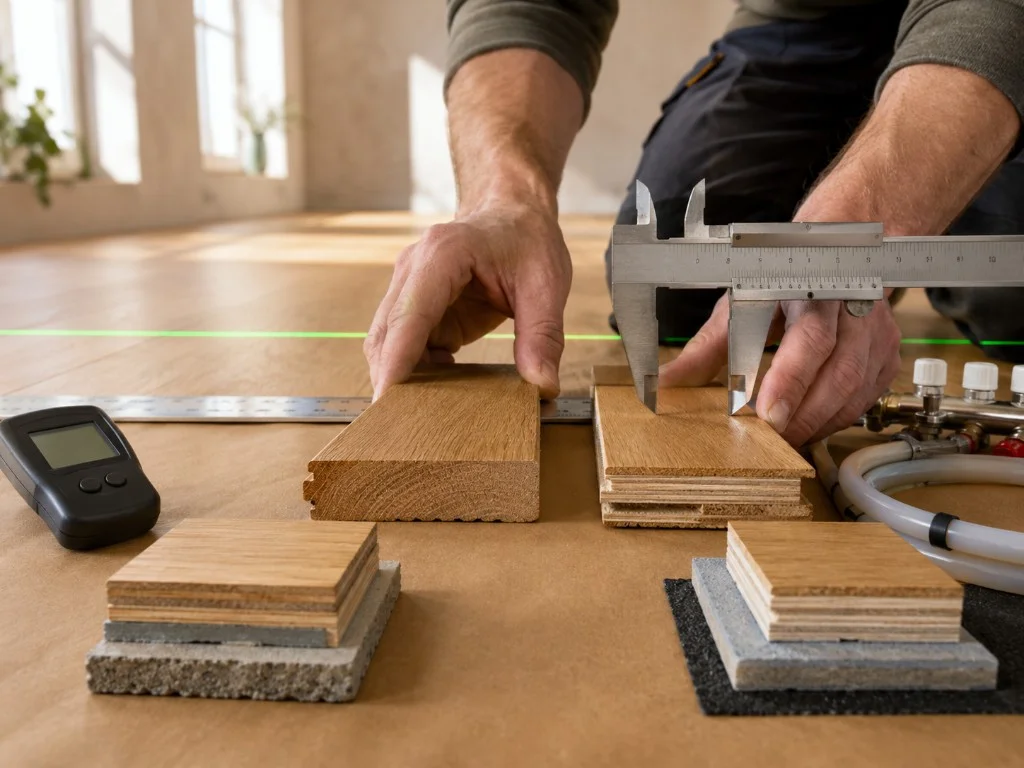
Both floors are real wood on top. The difference is how the build-up is made and where seasonal stress goes.
Solid — a homogeneous board: more working layer for future sanding and a stronger reaction to humidity swings. Engineered — a precious lamella on a stabilising core: calmer field, refinishing reserve limited by top-layer thickness.
“Which is better” without a site is marketing. Below are the criteria that belong in the specification.
How do they differ in seasonal movement?
Wood takes up and gives off moisture; boards change width. In solid, movement runs through the full thickness — on large fields and weak climate control the risk of gaps and cupping is higher.
In engineered board, cross-oriented core layers absorb part of the stress: seasonal joint opening is usually smaller for the same species and finish. That does not cancel perimeter expansion gaps or the right adhesive.
Board width and length, laying direction and substrate stiffness amplify or soften the effect — construction alone does not rescue a poor field.
Which lives better on underfloor heating?
Water and electric loops heat the floor from below and dry the timber locally. Engineered construction normally takes this more calmly: the stabilising core reduces severe cupping risk when surface temperature and stepped heat-up are respected.
Solid on underfloor heating is only an engineered exception: adhesive method sheet, temperature limit, confirmed screed moisture, narrower boards and operating discipline. “Everyone does it” is not a method sheet.
Before laying, lock substrate moisture and the first heat-up protocol. Without that, the “solid vs engineered” debate is empty: the floor is judged by cracks, not the catalogue.
Where is the sanding budget — and where is it not?
Solid 18–22 mm usually holds several full cycles over a floor’s life — if you do not sand down to the tongue or burn the edges. That is solid’s main argument on a decades horizon.
On engineered, sanding only touches the lamella. Guide ~2–2.5 mm — more often finish-only or one very careful pass; about 3 mm — usually one careful cycle; 4–6 mm — reserve for several refreshes. Box claims of “refinishes N times” without on-site measurement do not count.
We do not repeat the full lamella-remainder table and three outcomes before the machine — see parquet and engineered-board restoration. The point here: choosing construction chooses the future cycle budget.
Is humidity sensitivity the same?
Not in reaction amplitude — yes in the need for climate. Both solid and engineered are designed for a living range around 40–60% RH. Below that in the heating season without humidification, gaps appear in both; above — swelling, pressure on junctions and adhesive risk.
Engineered forgives short swings better; solid punishes a chronic “dry” or “wet” regime more honestly. Climate control is part of the floor project, not an option after handover.
Kitchen at the sink, winter garden and wet-shoe entrance are risk zones for any construction: local protection and care beat label debates.
What about acoustics and install height?
Room sound depends more on substrate, adhesive, plywood or underlay and joints than on the word “solid” on the label. Glue-down is usually quieter than floating; voids and play make any floor speak.
Build-up height: engineered is often thinner in the finished stack and easier under clean-floor level, thresholds and kitchen constraints. Solid on a plywood base adds height — lock that into sections before joinery is ordered.
Acoustic comfort is designed as a node (screed → adhesive/plywood → board → skirting), not by asking which timber type “sounds more noble”.
When does solid win, and when engineered?
Solid wins when the horizon is long, residence climate is stable, there is no underfloor heating or it is locked by a strict method sheet, and the client wants reserve for many restorations and “homogeneous” tactility.
Engineered wins on large fields, open plan, water or electric loops, tight height limits and when calm joints matter more than the maximum number of drum cycles.
Both types can share species, tone and a batch with doors. Construction is an engineering choice; optics are a separate layer. Residence decision order is in how to choose parquet.
In brief
Solid or engineered — which to choose?
Can solid go on underfloor heating?
What humidity does parquet need?
Which lasts longer — solid or engineered?
Which installs higher — solid or engineered?
Need a site diagnosis — describe the floor or joinery.
Request a quote