
Restoring parquet and engineered floors
Floors rarely fail overnight: first the finish dulls, then scratches and traffic paths appear by the sofa and in the hallway.
The real question is whether to refresh the finish, run a full sanding cycle, or replace the floor.
Here is parquet and engineered-board restoration without fairy tales: how much wear layer is left, how oil differs from lacquer when renewing, and when the machine only speeds demolition.
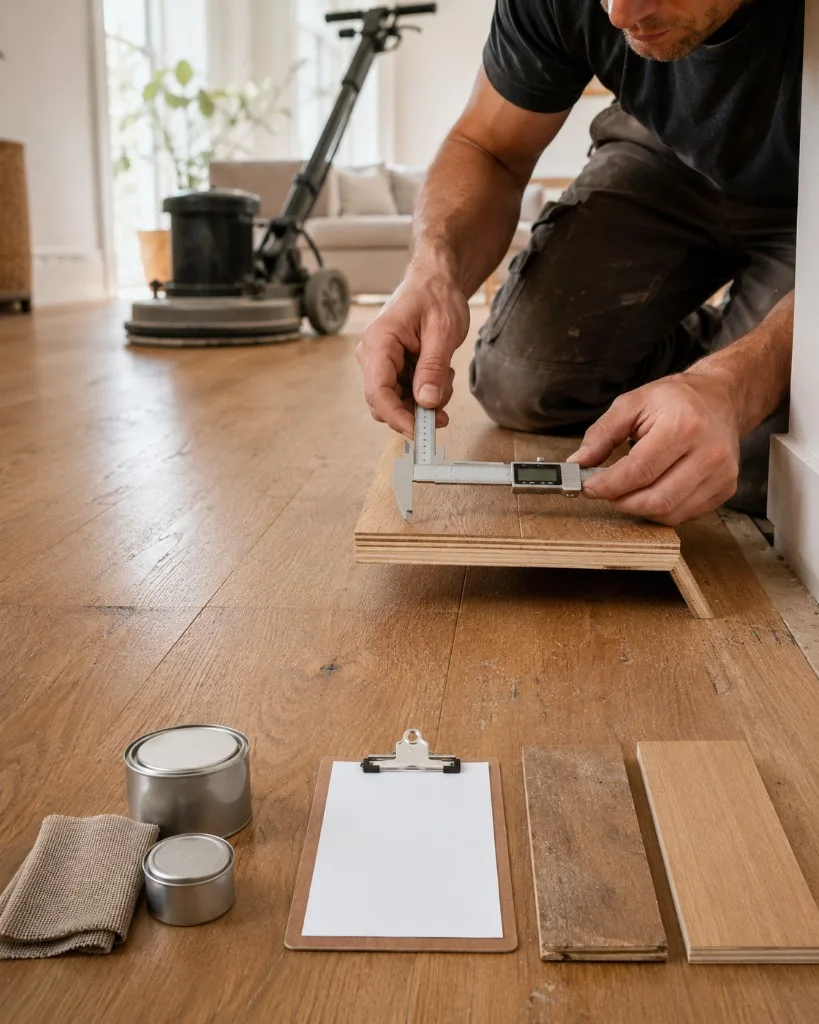
Sanding and “cycle” work are one process today: remove the old coating and level the plane before a new finish. Historically the tools differed; on site what matters is how many millimetres of real wood remain.
That is how both strip parquet and engineered board are renewed — if enough top layer remains. Floor restoration is not wipe-down cosmetics and not listed-building heritage work.
At the door there are always three outcomes: a full cycle, a soft finish refresh without cutting wood, or an honest replacement. Everything else is marketing.
Three outcomes before the machine starts
A full cycle — when wear is already in the wood: deep scratches, stains, washboarding, a colour change. Then we sand the plane, fill gaps, tone if needed and lay a new finish.
A soft refresh — when the wear layer is alive but the protective coat is tired: light screening and a new lacquer, or local oil renewal without a full drum pass. On thin engineered that is often smarter than sanding “for beauty”.
Replacement — when the lamella is spent, boards no longer hold, there was serious wetting or delamination. Then a new floor and installation are more honest than “sand it at any cost”.
How many cycles will engineered board take?
On engineered board, sanding only touches the top layer of valuable wood (the wear lamella). Under it sits a stable core — cut into that and the floor is ruined.
Guide by remaining lamella: under ~2 mm — a full cycle is usually pointless; about 2–2.5 mm — at most a very careful pass or finish-only refresh; ~3 mm — usually one careful cycle (a second only after a new measurement); 4–6 mm — reserve for several refreshes. One full cycle removes about 0.5–1 mm — depending on wear and skill.
The box often quotes factory thickness. On site what matters is what is left after past sanding and factory brushing: on textured floors the “working” millimetres in the valleys are less than on a smooth field.
And solid wood — how many cycles?
Solid 18–22 mm boards usually offer more wear layer than thin engineered — more cycles over a lifetime. Age alone says little: thickness to the tongue, coating history and past machine marks matter.
Thin engineered is not a defect — it is a different life budget. If the floor no longer holds a cycle, laying a new batch with wear-layer reserve is more honest than feeding the old board more abrasive.
Oil or lacquer — what changes in restoration?
Lacquer is a film: scratches often sit in the coating. A full cycle removes the film and a thin wood layer, then new lacquer in coats with interim sanding.
Oil / hardwax-oil goes into the pores: light wear is often closed locally — matte and oil refresh without a full drum across the flat. Deep grooves and a colour change still need a cycle.
You cannot “just pour lacquer over old oil” or the reverse without system compatibility. We lock the finish type at diagnosis — otherwise the new layer peels within a season.
How do you know sanding will hurt?
Red flags: the core shows in wear paths (not the species), pale burn-through, delamination, live play, leak marks, critical subfloor moisture, washboarding from old machines.
Brushed or hand-scraped texture becomes a smooth field after aggressive sanding — you do not get the texture back. If texture matters, refresh the finish rather than “flatten to zero”.
Small scratches on a living oil finish can sometimes be closed without a full cycle. A chat photo is not a gauge or moisture check.
How to measure the lamella before ordering sanding?
On site we look at an edge by a threshold, under a skirting, at a vent or a local repair — where the boundary between wear layer and core is visible. A calliper and experience beat a seller’s “refinishes five times” claim.
If there is no access — a careful probe in a future hidden joint or lifting one board. Better one honest board than the whole floor sanded into the core.
We record remaining thickness before start and state the outcome aloud: full cycle, finish refresh or replace. That is engineered-board restoration without a day-three surprise.
Can you sand a floor yourself?
On simple solid floors, basically yes: clear the room, rent a sander and edger, work coarse to fine, fill gaps and apply oil or lacquer per the maker’s guide.
In practice, without experience it is easy to remove too much wood, leave washboarding, burn corners or sand thin engineered through to the core — and then sanding cannot save the floor. Dust, noise and cure times are also easy to underestimate.
If the floor is expensive, the area is large, the pattern is complex or you are unsure about lamella thickness — better professional sanding. Measure first, dust extraction, a clear result at handover — not “sanded and gone”.
How does a job run with us?
Diagnosis and measure → room protection → coarse and finish sanding with dust extraction → filling and tone → oil or lacquer → handover with a care card. Timelines depend on area and cure.
After handover, about 40–60% indoor humidity and compatible cleaners help — see parquet care. Listed buildings are a separate heritage track.
In brief
Can you sand engineered hardwood?
How is a full cycle different from a finish refresh?
Can you sand a floor yourself?
How many times can you refinish parquet?
Do you sand with dust control?
How much does restoration cost?
Need a site diagnosis — describe the floor or joinery.
Request a quote