
Parquet sanding & refinishing: stages and timelines
On site, sanding sounds simple: “grind and coat”. In practice it is a grit ladder, edges, filling, dust extraction and cure hours — and only then a clean tone.
The one question is a full coating strip or a soft finish refresh without spending an extra millimetre of wood.
Here is the operational process: when a full cycle is needed, how grit runs ~40–60 → 80–120 → 150–240, how oil differs from lacquer on walk-vs-furniture timing, and how the room is prepared before the machine starts.
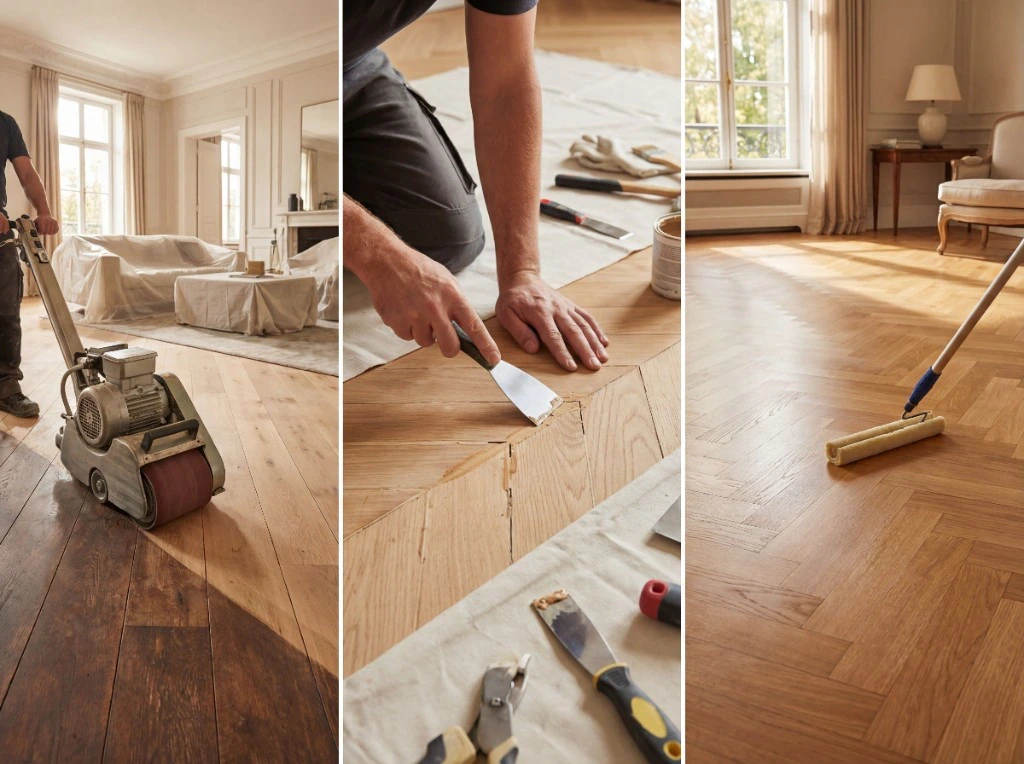
Sanding and “cycle” work today are one process: remove the old coating, level the plane, close joints and lay a new finish. Historically the tools differed; on site what matters is grit, dust and coat cure.
How many cycles engineered will take and how to measure the lamella — that is parquet and engineered restoration. Here — how the job runs once the cycle is chosen.
Private homes and commercial spaces are a service track. Listed heritage (OKN) is a separate approvals discipline — not “the same machine, faster”.
A full cycle is not always required
A full cycle — when wear is already in the wood or the coating must come off entirely: deep scratches, stains, colour change, peeling lacquer. Then we climb the grit ladder, fill, tone if needed and lay a new finish.
Screen-refresh — when the wear layer is alive but the protective coat is tired: light screening, new lacquer or local oil renewal with almost no wood removal. On thin engineered that is often smarter than running a drum “for shine”.
Choose the outcome before the machine starts. Lamella millimetres and red flags live in the restoration article; here we lock the scenario and the cure calendar.
The grit ladder only goes up
Coarse (~40–60 grit) removes old coating and major unevenness. Intermediate (~80–120) clears the scratch from the coarse pass. Finish (~150–240) prepares the field for tone and finish — without abrasive “steps” in raking light.
Skipping a step or jumping from 40 straight to 180 leaves scratch that lacquer only highlights. Pass direction and grit changes follow the object card — not “by eye on a stain”.
One full cycle usually removes about 0.5–1 mm — exact figure depends on wear and skill. Lamella limit is decided before start, not mid-drum.
Edges and corners reveal the job
A drum or belt machine does not reach the walls. An edger and hand work in corners are mandatory — otherwise you leave a “frame” of old lacquer and a height step.
By radiators, in niches and at thresholds burn-through risk is higher: less shoe support, easier to dig a corner. On thin engineered the edge is the highest-caution zone.
Skirting is often removed or masked before start: dust and abrasive must not live in the gap until handover.
Filling holds joint geometry
After coarse and intermediate steps, joints and small defects are closed with filler from the same species dust or a compatible system — so tone and movement track the field.
Filling is not “seal the gap forever”. In unstable climate micro-gaps can return; the job is a level plane under finish, not the illusion of a monolith.
After filling, another fine sand: leftover filler on the field stains under lacquer and oil.
Dust extraction is a finish condition
Dust between coats causes craters, roughness and poor adhesion. We work with machine dust extraction and before every finish coat: vacuum, anti-static per the system card.
We do not promise absolute “zero dust” as a slogan: sealed openings, film and closed zones cut spread through the flat, but during the cycle the object is a work site.
Tone and finish go only on a clean, dry field. Saving on dust costs more than recoating a layer.
Oil and lacquer live on different clocks
After sanding and tone — finish per the maker’s card (Osmo, Saicos, Bona, Pallmann and equivalents). Coat count and interim lacquer sanding are not “by eye for gloss”.
Load guides (confirmed by the system datasheet): light sock traffic — often within hours or the next day; furniture without dragging — later; full household and point loads — when the coat has built strength. Oil and hardwax-oil usually open soft use sooner; lacquer builds hardness longer between coats and to full load.
Cure climate: steady ~40–60% RH and project temperature. Drafts, cold and “blast heater on” break a coat as surely as dirt on the field.
The object is prepared before the machine starts
Clear the room: furniture, textiles, appliances. Stable humidity ~40–60%, no active leaks, dry subfloor. Otherwise we sand into a problem and lock it under finish.
A flat of ~80–120 m² — often about 5–10 working days including coat cure; timeline flexes with area, coat count and scenario (full cycle vs screening).
We work on our own parquet and third-party floors — after coating audit and wear-layer thickness. Compatibility of old oil/lacquer with the new finish is checked before material is bought.
Can you sand a floor yourself?
On simple solid — basically yes: clear the room, rent a sander and edger, work coarse to fine, fill joints, honour oil or lacquer cure per the instructions.
In practice, without experience it is easy to leave washboarding, burn edges, trap dust under a coat or break the cure calendar. Thin engineered and artistic sets are where a mistake is often irreversible.
If the floor is expensive, the area is large or you are unsure of the scenario — better professional sanding: diagnosis, dust extraction, a clear result at handover.
A private cycle is not the heritage track
In a residence or office, sanding renews geometry and finish without heritage approvals. That is Cardinal Hall’s service track.
Listed cultural-heritage objects (OKN) are a separate discipline: archive, methods, approvals. Not a fast “sand the living room”. The heritage section sits in the cultural-heritage catalogue.
After handover the floor lives in care mode: 40–60% climate, compatible products — see parquet care.
In brief
How is sanding different from a finish refresh?
What grit is used when sanding parquet?
How long does lacquer or oil cure after sanding?
Do you sand with dust extraction?
Can you sand a floor yourself?
How does flat sanding differ from listed-building work?
Need a site diagnosis — describe the floor or joinery.
Request a quote