
Heritage restoration: approvals, archive and the residential sanding fork
On a listed building the argument is rarely about “nice lacquer” — more often about the right to touch a layer and the document without which work does not start.
The real question is residential sanding of a mansion, or a heritage track with archive and approvals.
Here’s the fork: KGIOP/DKN, documentation and methods versus private sanding — and why this must not be mixed with catalogue wood restoration.
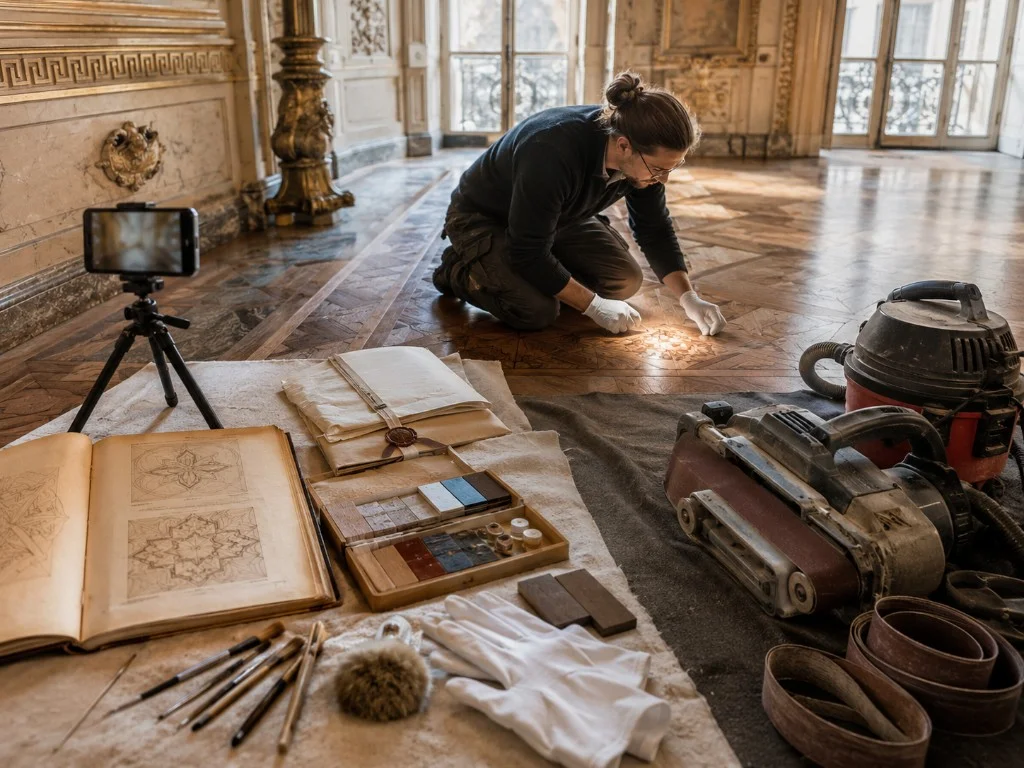
Heritage (listed-building) restoration is not “the same sanding, only slower” and not the catalogue wood-restoration service track.
It is a legal and method track: building status, archive, project, samples, access windows, acts.
A private mansion without protected status lives on service logic: diagnosis, cycle, care.
Below — where the fork sits and what you cannot promise “as in a flat”.
Why status and archive before the machine?
Protected status sets what may be removed, what must be recreated and who approves. Without that, any “trial drum pass” risks the building and the contract.
Archive drawings, layer photography, species and finish samples are the project entry — not a pretty report add-on.
Working with conservation architects and access regimes (museum, theatre, temple) shape the calendar more than parquet square metres.
What do KGIOP and DKN do in this track?
Approving bodies (KGIOP / DKN logic and regional equivalents) review documentation, methods and fit to the protected subject — not whether the client likes the tone.
Timelines are measured in approval iterations: months, not residential sanding days. A calendar without those windows is fiction.
We put approval stages in the contract explicitly. Promising “we’ll do it like a residence, only quieter” on a listed object is not allowed.
How does the heritage track differ from residential wood restoration?
Catalogue wood restoration is sanding, finish refresh and local repair in residences and commercial spaces without listed status. There you decide lamella, oil/lacquer compatibility and the honest outcome cycle / finish / replace.
The heritage section is recreation and conservation in a legal field: lost fragments, historic patterns, boiserie, stairs and doors in listed buildings, long approvals.
Mixing these in one estimate and one marketing line is wrong: different briefs, timelines, liability and teams. We say the fork aloud at the first meeting.
What does a typical listed-building cycle look like?
Survey and historic-archive search → restoration project → material and finish samples → approvals → element production → install in site access windows → records, acts, service card.
Parquet mosaics, boiserie, stairs, doors and panels account for museum and audience loads — not “as at home by the sofa”.
Pattern recreation meets craft set geometry — see also artistic parquet — without reducing it to “draw something similar without archive”.
Can you “just sand” a listed building yourself?
On a listed object DIY with a machine is almost always worse than waiting: you can remove a historic layer, break the method and face conservation claims.
Even “careful screening” without an agreed scope is a risk. Flat DIY logic does not transfer here.
If the building has no status — another conversation: service sanding and care. If status exists — project track only.
How do we run these projects?
A separate team and contract from the residential track. Status and archive first, then production and install in approved windows.
Geography: production in Russia, travel and author supervision by agreement, including outside Moscow. Time and cost — after survey and understanding the approval pack, not “from N ₽/m²” on a showcase.
In brief
How does listed restoration differ from sanding a mansion?
Where does a heritage project start?
How long do listed works take?
Can you recreate a lost parquet pattern?
Do you work only in Moscow?
What does listed restoration cost?
Need a site diagnosis — describe the floor or joinery.
Request a quote