
Artistic parquet: module geometry without error accumulation
Artistic parquet rarely fails from bad taste — more often from a millimetre missed on the module.
The real question is a pretty drawing on paper, or geometry with tolerance from CAD to laser on site.
Here’s error accumulation: why 1 mm on a medallion becomes centimetres of shift across a hall, how diagonals and CNC work, and how heritage differs from a private set.
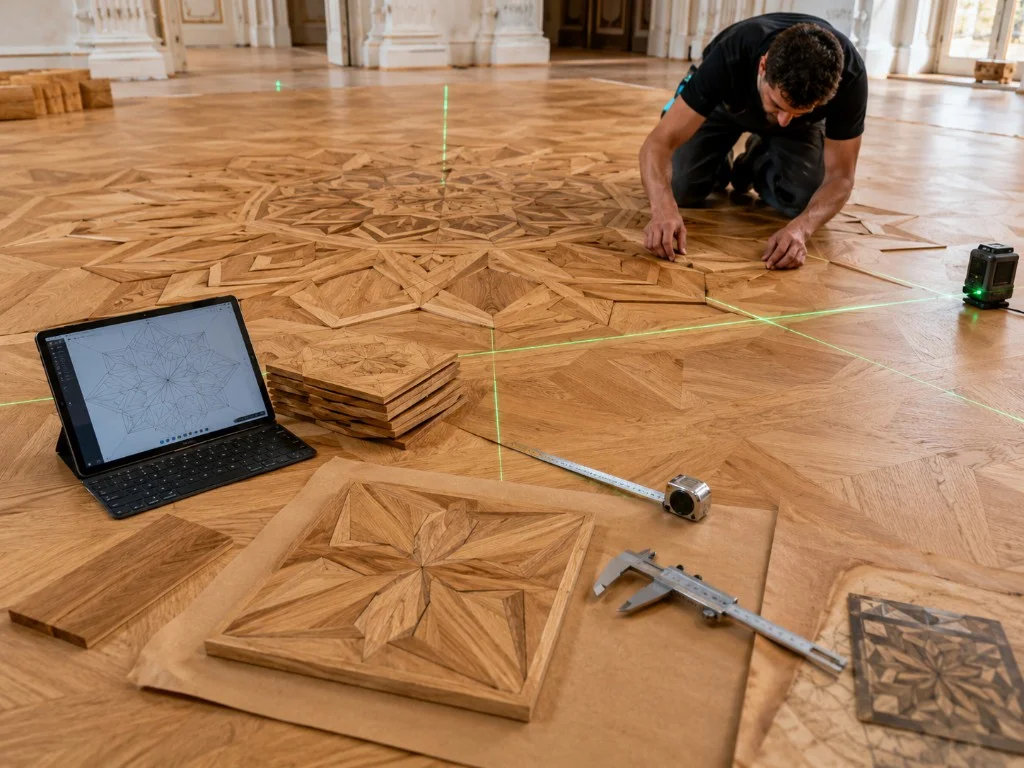
Artistic parquet is not a pattern sticker. Historically medallions and borders were set by hand dry; today the same job uses survey, CAD and CNC — but the rule is unchanged: geometry beats décor.
It is craft geometry: module, angle, diagonal, tied to hall axes, doors and columns.
A 1 mm module error becomes centimetres of shift after many repeats and breaks junctions with architecture — even with the “right” species.
Below — the shop line: from drawing to CNC and install, without “as under the tsars” romance.
Why does 1 mm on a module become centimetres across a hall?
A module or medallion is a repeating cell. If a side or angle drifts by a millimetre, after ten–twenty repeats the shift is centimetres: the joint wanders, the border misses the door, the hall centre leaves the axis.
The eye sees it late — when the pattern is already in adhesive. So tolerance is caught in production, not “trimmed on site somehow”.
Module and panel diagonals are a fast check: unequal diagonals mean the rectangle is already gone, and the field will multiply it.
How does the CAD → CNC → shop chain run?
The pattern first lives in CAD tied to survey: axes, columns, portals, niches. Without that, a “nice motif” is a picture — not a product for the hall.
CNC cuts from the same model: pieces and panels with angle control. Hand finishing remains — on verified geometry, not instead of it.
Species and finish come from the same batch as field parquet and related joinery. Otherwise the artistic centre ages on its own in tone and shrink.
Why laser layout on site?
Laser layout locks axes before the first module. “By eye from the wall” almost always accumulates the same millimetre error — only already in the room.
Adhesive bed, humidity and temperature follow protocol: geometry will not save a moving substrate or a batch that never acclimatised.
Sanding and finish come after the full pattern is assembled. Otherwise you flatten what neighbouring modules will still shift.
How does heritage differ from a private set?
On a private project the job is a precise modern set: stable build, one batch with the field, install by card. That is Cardinal Hall’s service track.
Listed buildings add archive, methods and approvals. Recreating a pattern is not “draw something similar” — it is a documented track. More in heritage restoration.
Eighteenth–nineteenth-century techniques evolved: kiln drying and CNC give precision hand dry-set never had. The principle remains — geometry over decoration — the tools are different.
Can you assemble an artistic set yourself?
In basic terms — a simple border or small module on a flat substrate: if you have a dimensioned drawing, diagonal checks and patience for fit-up.
In practice it is easy to accumulate drift, trim the wrong angle and get a joint that lacquer only emphasises. Complex medallions and diagonal layouts are where mistakes cost dearly.
If the hall is large, there are columns and portals, or tone must match doors in one batch — better a shop with CAD and laser layout on site.
How does a job run with us?
Survey and CAD → module production with diagonal control → site layout → install → sanding and finish → handover. Timelines depend on pattern area and finish cure.
After handover the floor lives on care: about 40–60 % RH, compatible products. Field without an artistic centre — in the parquet catalogue; install discipline — in the laying guides.
In brief
How is artistic parquet different from a decorative “sticker”?
Why do module diagonals matter?
Can you recreate a historic pattern?
Do you need one batch with field parquet?
Can you lay an artistic set yourself?
What does artistic parquet cost?
Need a site diagnosis — describe the floor or joinery.
Request a quote