
Restoring stairs and wall panels
Stairs and panels rarely fail overnight: first the finish dulls, treads show wear, somewhere a squeak appears.
The question becomes whether to refresh the coating — or fix joints and tone in line with the floor.
Here’s why a squeak returns after “just sanding”, how treads and boiserie are renewed, and what care matters after handover.
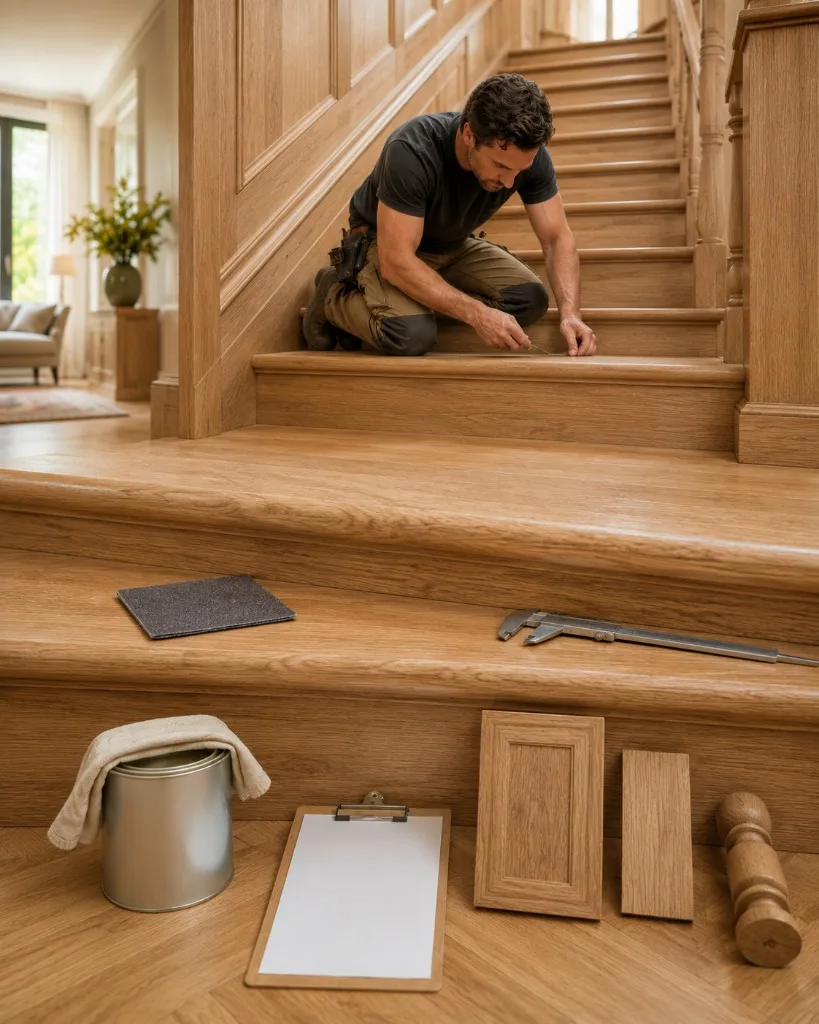
Restoring stairs and panels is not varnish over a squeak and not listed-building heritage work.
On the march we find play and geometry first; on panels — flatness and tone next to floor and doors.
Treads wear harder than a living-room floor: finish here is usually tougher and refreshed more often.
After handover, climate and compatible cleaners matter — or the new coat does not last.
Why does the squeak return after sanding?
A squeak is almost always micro-play: tread to stringer, riser, fixings, wood shrinkage. Tighten, glue, sometimes replace a part — before sanding and finish.
Fresh lacquer or oil over live play only conserves the problem: the squeak returns within a season. A new march with load calculation is a separate project; here we restore what already stands.
How are treads and rails renewed?
Treads take the heaviest load. Sanding is often orbital and hand work on profiles, then a tougher finish than on verticals. Noses and edges get a separate look — coating fails there first.
Oil on treads refreshes locally and more often; lacquer lasts longer as a film, but patch repairs are harder — often the whole march is recoated. Choose for traffic and maintenance readiness, not “what looks nicer on a sample”.
Rails and balusters are their own loop. A loose or chipped baluster is often replaced in the same species and tone rather than patched: that is appearance and railing safety, not cosmetics only.
How do you match panels to the floor?
Most often we work in place: strip coating, fill, tone, finish. If panels cupped, veneer is worn through or the layout drifts — partial or full replacement is more honest.
We align panel, door and floor tone in one species and finish system — otherwise you get three oaks in one room after handover.
Can you fix a squeak and refresh treads yourself?
In basic terms, yes on a simple march: find the play, tighten or glue the joint, then sand coarse to fine and apply oil or lacquer per the maker’s guide.
In practice it is easy to pull the wrong fastener, leave washboarding on a tread, burn a baluster profile or pick a finish that wears off treads in a season. Dust in the well and cure times are also easy to underestimate.
If the stair is expensive, carving is complex, there are winders or you are unsure of the joint — better get an inspection. We stop the squeak first, then sand and hand over a finish built for foot traffic.
When is replacement better than restoration?
If treads are worn past a safe thickness, march geometry has gone, parts are rotten or the cycle costs near a new march — we say so before work starts. We can also quote a solid stair with load calculation.
For panels the threshold is the same: sound plane and tone — restore; cupped / veneer spent — replace a fragment or the layout.
After handover: care and maintenance?
About 40–60% RH year-round. In winter without humidification air often drops to 20–30%: wood dries, play and squeaks return even under a fresh finish — lacquer and oil only slow that, they do not cancel it.
Cleaning — soft, no puddles, no steam mop, no harsh chemistry. Oiled treads refresh more often than a living-room floor; lacquer less often, but local repair is harder. Full product guidance lives in a separate care guide; the same principles apply to panels and joinery.
How does a job run?
First diagnosis of joints and scope, then room protection, play fixes, sanding of treads and verticals, tone and finish, handover with clear care notes. Timelines depend on march area, panels and cure.
After handover, wood lasts longer in a stable climate. Need replacement — production and install. Protected heritage sites are a separate track.
In brief
Can a stair be restored without dismantling?
Will the squeak return?
Panels matched to the floor?
Can you fix a squeak yourself?
Oil or lacquer on treads?
Repair or replace a baluster?
How do you clean treads and panels?
What does stair restoration cost?
Need a site diagnosis — describe the floor or joinery.
Request a quote