
Restoring furniture, kitchens and doors
Wood furniture rarely fails overnight: first the finish dulls, chips appear, fronts stop closing square.
The question becomes whether to renew surfaces and joints — or replace the front / leaf.
Here’s how solid differs from thin veneer in restoration, what can still be saved on kitchens and doors, and when a new piece is the honest answer.
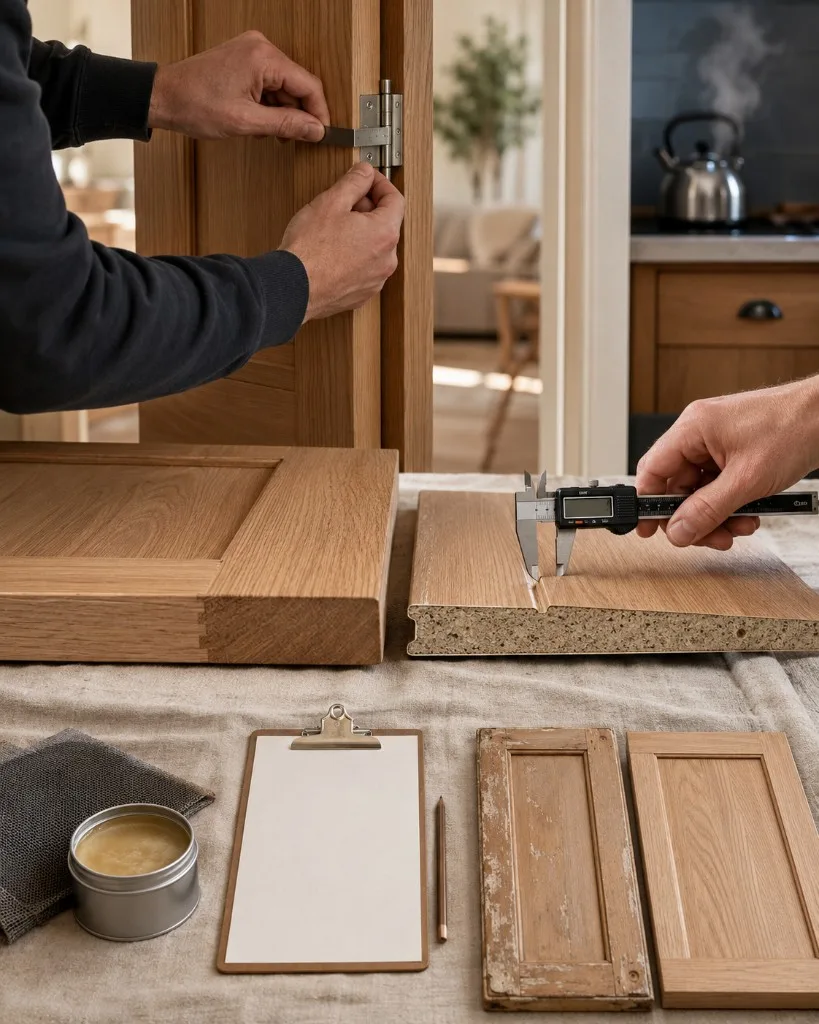
Restoring furniture, kitchens and doors is not marker touch-ups and not listed-building heritage work.
It is reading the build: decorative-layer thickness, geometry, hardware, moisture and joint wear.
Solid wood tolerates several careful cycles; thin veneer on board — one careful pass or local repair.
Then tone and a protective layer for real use: steam and grease in a kitchen are harsher than a living-room floor.
How does solid differ from veneer in restoration?
On solid wood the working layer is the timber itself: you can sand, insert species-matched patches, repair tenons and rails. Veneer is a thin valuable skin — often fractions of a millimetre on MDF or chipboard.
Aggressive sanding burns through veneer to the core: then re-veneer or replace the front. We read edges, lipping and wear — a local chip versus fatigue across the plane.
Can kitchen fronts be restored?
Solid or sufficiently thick veneer fronts are renewed with sanding, tone and a finish rated for moisture and grease — not shelf varnish. Carcasses are judged separately: sometimes only fronts need work.
It makes sense when door geometry is sound and the frame has not swollen at the sink. If water warped fronts or veneer bubbles — fix the cause first, then choose restore or replace.
In practice there are three paths: refresh the finish on sound fronts; replace fronts only when boxes are fine; replace the whole kitchen if the carcass and layout no longer hold. “Just repaint” usually mixes these three up.
Why does door geometry matter more than colour?
The common ask is “just repaint”. Hinges, fit, sag and gaps are usually the real issue. Geometry and hardware first, then sanding and finish matched to floor or panels.
Veneered leaves on an unstable core need a gentle hand. If the leaf is twisted, swollen or has lost stiffness — a new leaf in the existing opening is more rational.
Can you refresh fronts yourself?
In basic terms, yes on simple solid wood: remove hardware, work coarse to fine grit, fill chips, apply oil or lacquer per the maker’s guide — and let coats cure dust-free.
In practice it is easy to sand thin veneer through to board, tear an edge, burn a profiled moulding or pick a finish that fails under kitchen grease and steam. Matching colour to a neighbouring front also rarely lands on the first try.
If the suite is expensive, fronts are veneered, profiling is complex or you are unsure of the build — better get an inspection. We learn what still holds a cycle and hand over a clear result — not “sanded and gone”.
When is replacement better than restoration?
If veneer is spent, carcasses are swollen, fronts warp, hardware no longer holds or the cycle costs near new fronts — we say so before work starts. We can also quote furniture or a kitchen in the same species logic.
The verdict is always one of three: full cycle, local refresh or replace the part. Heritage stays on a separate track from domestic work.
How does a job run?
First diagnosis and agreed scope, then room protection, joint repair when needed, sanding, tone and finish, hardware refit and handover with clear care notes. Timelines depend on area, cure and whether fronts come off.
After handover, stable climate and compatible cleaners help wood last. Need replacement — production and install. Protected heritage sites are a separate track.
In brief
Can veneer be restored?
Kitchen restoration — fronts only?
Doors without replacing the frame?
Can you refresh fronts yourself?
Can you just repaint a kitchen or doors?
What does furniture or kitchen restoration cost?
Need a site diagnosis — describe the floor or joinery.
Request a quote